Melissa

Melissa lives in Florida USA and in 2012 and 2013 planted her own seeds and submitted photos of her sunflowers to help raise awareness of centronuclear and myotubular myopathy.

Melissa and her husband Matt are the founders of Hope from Harrison, a charity committed to raising awareness and resources for the families of critically needy children who require hospital or in–home medical care.

Hope From Harrison was created to honour the life and memory of their son Harrison Everett Hudson while providing relief, knowledge, reliable in-home care, and other specialty services tailored to individual patients and family needs.

Kay and Luke

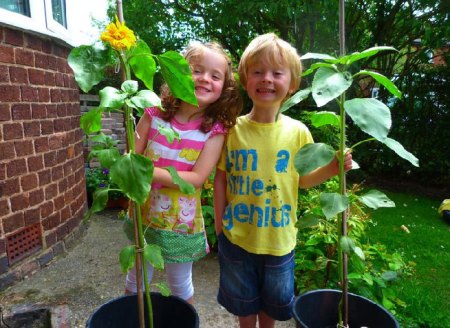
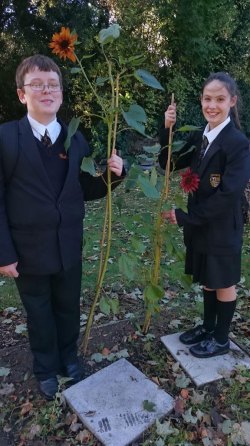
Kay and Luke live in Connah’s Quay and have taken part in The Big Sunflower Project every year since it started in 2011. Luke and Kay are always very creative in the way they grow their sunflowers – using chopsticks and pencils as supports for their plants and planting their seeds in custard pots which they put down to their growing success.

Luke and sunflower

Helen, Paige and Ollie

Twins Ollie and Paige along with their mum Helen have been growing sunflowers for the Big Sunflower Project at their home in Chester since 2011 when the twins were just four years old. In 2011 Paige’s sunflower was the very first of all the sunflowers to bloom and she also received a certificate from her school teacher for knowing so much about how to take care of seeds. Paige’s advice for growing sunflowers – they need a whole lot of love.

Paige and Ollie

Hazlehurst Studios

Hazlehurst Studios is situated in the heart of Runcorn and houses artists with expertise in a range of disciplines including photography, textiles and printmaking. In 2014 the studios worked with the town development team and Halton Borough Council’s Arts Development team to encourage community groups, schools and residents to come together and create a garden on the high street with the aim of brightening and raising the profile of the area as somewhere people care about, as well as passing on some of the valuable skills of art and flower planting, to name a few. Recycling was also a key part of the project, with groups using tins as plant pots, which they painted in bright colours and designs.

The Studios were enthusiastic participants growing an amazing number of sunflowers and also helping promote The Big Sunflower Project in a number of ways including sharing their photos on Facebook and Twitter and running an adoption scheme for the sunflowers they grew.

Alden and sunflowers

Girvan Community Garden

In 2006 the community of Girvan in Ayrshire decided to turn a piece of land that had lain derelict for over 30 years into a community garden. The garden officially opened in 2011 and today, after much hard work, the garden caters for the whole community with its pond, a wildlife area, fruit trees, greenhouse, raised beds, a ‘keyhole’ garden and a composting area. The garden has easy access through a woodland walkway for prams and wheelchairs and a composting disabled accessible toilet.

The garden believes in community wellbeing and better health through gardening. It plays host to workshops, events and activities throughout the year and is involved with schools and other groups delivering projects both in the garden and out in the wider community.

Volunteer coordinator Julie Campbell says: Girvan Community Garden took part in The Big Sunflower Project because we simply love sunflowers, they are friendly flowers that everyone recognises and loves to see and they are totally insect friendly too. More importantly it makes more people aware of the work the Information Point is doing to help raise awareness for centronuclear and myotubular myopathy.

Sunflower grown at Girvan Community Garden

Gary, Jill, Harry, Hayley, Ellsie and Paddy the dog

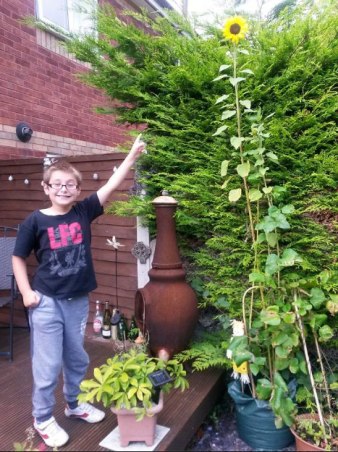
The Beck family live in Bradford, West Yorkshire and have taken part in the project on two occasions because Harry has myotubular myopathy. Gary says:

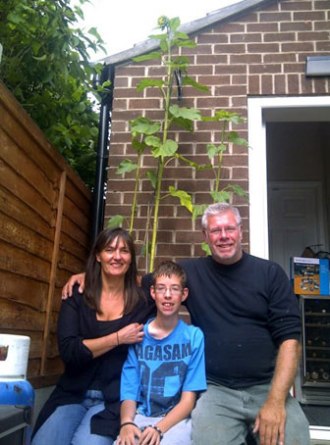
I forget exactly when we planted them but we put three seeds in yogurt pots in the kitchen, covered with cling-film. They started growing within a couple of weeks and when they reached around 10″ or so we put them outside in pots. We were all amazed how fast they grew and within a few weeks they had outgrown the pots, so we again uprooted them and put them into a wooden planter outside the back. Luckily this is in the sun for several hours a day so we couldn’t wait to see them actually flower.

The main question in our house each day was “Has anyone watered the sunflowers today”? I think they were probably over-watered several times! Due to the high winds we were having I had to put canes in to tie the sunflowers to. Then one day in early September I came home and saw a beautiful sunflower in full bloom – I was so excited that I ran in telling everyone to come outside to see it and how amazed I was that it had flowered in one day but all I could see was everyone in stitches laughing at me.

Eventually they stopped and asked me to go outside and look again which I did but at first I didn’t see the fake plastic sunflower that Jill had tied to the real one!!! Luckily within a week or so the tallest of the flowers did actually bloom and it was a ‘belter’. I stand just short of 6ft and the flower was a couple of feet above me. Within a week the other two had also flowered but were slightly shorter.

Sadly when we had some real strong winds the shortest of the flowers snapped and died but we enjoyed the other two for a while before they too wilted. We were all amazed at the number of bees and other things that were attracted to the flowers and would happily grow them again next year. We all thoroughly enjoyed growing the flowers and listening to our visitors commenting on the size of them.

The second time the family took part, they decided to have a family competition to grow the tallest one. Gary says:

I planted six seeds in identical cardboard pots for myself, Jill, Harry, Hayley, Ellsie and Paddy the dog, with each person/animal’s name written on it. The intention was that everyone would lovingly tend and water their own pot. Sadly this didn’t happen as planned as the water soaked through the pots and virtually destroyed the names plus nearly all the watering and caring was left to yours truly each day.

Even in their tiny pots there were front runners in the tallest flower stakes, the lead changing hands several times between Harry and Paddy. By the time they grew to around a foot or so I moved them into larger containers and moved them outside. Being a little upset that I had done all the watering and nurturing, my plant was by several inches the smallest one on show. This meant that my flower merited it’s own outside pot – the other five sharing two pots. The tallest plant changed between Paddy, Jill, Harry and grandaughter Ellsie – mine being a consistent last place.

It was quite obvious that none of the flowers would reach anything close to our previous efforts – some of this was due to the incredibly strong winds which actually snapped one of them. My flower – as well as being the smallest was the last to actually bloom but because of this was also last man standing when all the others had wilted away. I did however have the last laugh as my large flower also sprouted three other flowers all from the one stalk. I had never seen this before and was feeling particularly proud of my ‘late starter’ until I saw that Darran from Doncaster had eight flowers on one of his. Oh well – here’s to next year. Even though they weren’t as tall as before, several people commented on our display and we even gave some seeds out to our neighbours and family ready for the next year.
Gary and family

Gardens for All

Gardens for All is a community based project spanning various different sites across Bury and Prestwich in Manchester which aims to encourage all members of society to become actively involved in gardening, sustainability and grow your own projects.

The project focuses on improving the integration of vulnerable members of society as well as promoting improved health and wellbeing and self confidence through learning new skills and sharing success with other members of the project. Anna from the groups says:

We grew our sunflowers on the John Denmark Unit at Greater Manchester West hospital by the patients. The Unit is a specialist centre for deaf people with mental health issues. Deaf people communicate through a visual language of sign or other visual forms of communication, therefore these striking beautiful sunflowers are particularly appreciated by them.

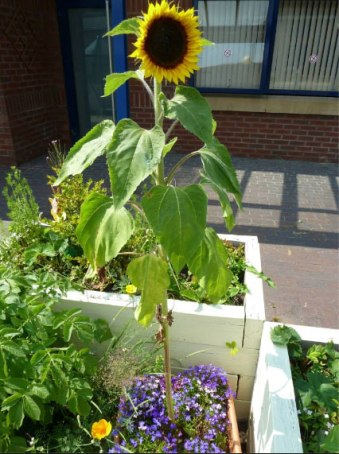
We started growing them in a heated propagator in the greenhouse in small pots, they all germinated quickly and we potted them on to bigger pots in the greenhouse, eventually once the weather warmed up a bit we put them outside in large pots with lobelia trailing around the bottom.

We had a bit of a disaster when the greenhouse wasn’t watered and lost a few plants so our sunflowers were real survivors. We were really very pleased with our beautiful sunflowers, they caught up well after a cold start to the season and we are all enjoyed their sunny bright faces.

Sunflower grown by Gardens for All

Mike and Diane

Mike is diagnosed with centronuclear myopathy and in 2011 him and his wife Diane  chose to grow a dwarf variety of sunflower called Pacino. They started their seeds off in the bottom of recycled plastic milk bottles which were placed outside during the day and taken back inside at night. The plants were later transferred into bigger pots to give the roots room to grow. The technique worked well as by July they had pots full of sunflowers.

Dwarf sunflowers grown by Diane and Mike

Elly

Elly took part in The Big Sunflower Project for the first time in 2013 shortly after being diagnosed with centronuclear myopathy. Elly says:

I thought it was a great idea that people from all over the world could be involved by sharing photos. I bought a packet of seeds when I went shopping and planted a tray of six. I kept them in my mini greenhouse for two weeks before transferring the seedlings to pots in the garden. I put one of the sunflowers in a raised border, but this was soon destroyed by slugs, so the rest stayed in their pots.

The five sunflowers all grew at different rates, it was lovely seeing them developing and adding colour to the garden. The only problem I had was keeping them upright, as the slightest wind would blow them over.

Sunflower grown by Elly

Calderstones’ Eco School

Calderstones’ eco school is a large comprehensive school in Liverpool with over 1540 pupils.  The school first took part in The Big Sunflower Project in 2014 and since then have been enthusiastic participants taking photos and posting these on Twitter to raise awareness of centronuclear and myotubular myopathy and even getting the project a mention in Educate magazine which goes out to all schools across the Merseyside region and is distributed at many outlets for parents and students to access. Emma, a teacher at the schools says:

I found out about The Big Sunflower Project on Twitter in 2014 and it was a complete no-brainer that our school got involved. We have a team of young Eco Leaders at Calderstones who work on the allotment for extra-curricular enrichment. And, along with our key stage three pupils (who get to take part in Green Corner lessons as part of our PSHE Scheme of Work) all got to be  involved in sowing, growing and nurturing the flowers and produce at the allotment. One of our youngest and keenest Eco Leaders, Cameron, had an opportunity to further contribute to the project by writing a little blog which was featured on the Project Dirt website – a proud moment for Cameron.

Our school allotment has been a fantastic way of getting our pupils to learn outdoors over the last couple of years and the growing of the sunflowers has provided a real highlight in the summer term.

We challenged ourselves to grow 100 sunflowers and show their progress via photographs on Twitter, Project Dirt and our school website. Pupils have enjoyed experimenting with different varieties of sunflower and monitoring their growth patterns and our sunflowers are still blossoming.

Staff got involved by growing their own blooms at home and alongside students at the Green Corner. Some form classes got to recycle tin cans, turn them into planters, and grew sunflowers in them for their desks.

* Calderstones’ Eco school website
* Cameron’s blog

Pupils at Caldies Eco School in Liverpool