Meleena (Fulbourn Primary School)

To be honest I had never heard of The Big Sunflower Project and I had most certainly not heard of centronuclear and myotubular myopathy before 2017.

I received an email through school about taking part – I run a primary school gardening club and I thought “Yes, why not get involved”.  What a great way of combining growing something from seed and explaining how some peoples’ bodies do not grow strong because that have rare disorders.  A few of the children struggled to understand fully the impact of centronuclear and myotubular myopathy (quite complex when you are only 5) but they all grasped how some people are born different and have illnesses or disabilities.

The sunflower seeds arrived in their little brown packet and were eagerly received by the gardening club children.  Some of the children had not grown sunflowers before and to which ends we set about planting up one seed in a pot for each child in the club to take home and nurture.  The home results were mixed!  Some were forgotten and left without water, some were planted out too early and eaten by slugs, some were dug up by cats!  The ones that were given care and attention grew big and strong and added a splash of colour to the children’s garden.

The remaining seeds were broadcast sown in an area that had been dug over in our wild life area.  The seed were added to by a local farmer and the results were quite astounding.  A whole host of sunflowers that Van Gogh would have been pleased to paint.

We subsequently harvested the ripened heads (after explaining that each seed has been formed by an individual flower – wow!) and they are drying in our poly tunnel ready for planting again next year.  We will also pass some of the seeds on to other local schools and hope to raise awareness of The Big Sunflower Project for 2018.
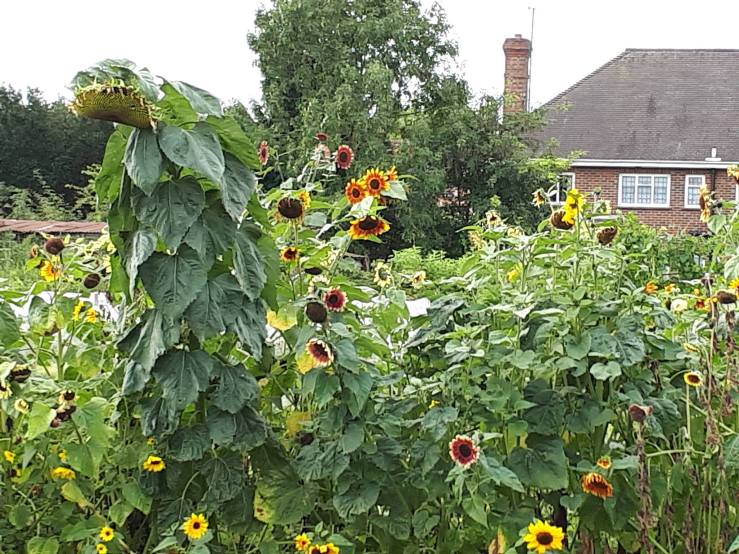
Sunflowers grown at Fulborn Primary School

Nish

Nish lives in South Oxhey in the UK and took part in The Big Sunflower Project in 2017. Below he writes about taking part in the project.

My favourite flower are sunflowers. I also have a belief that whatever you sow into the ground, you have a chance that it may grow regardless of the external conditions. It just requires a little bit of hard work and a lot of faith.

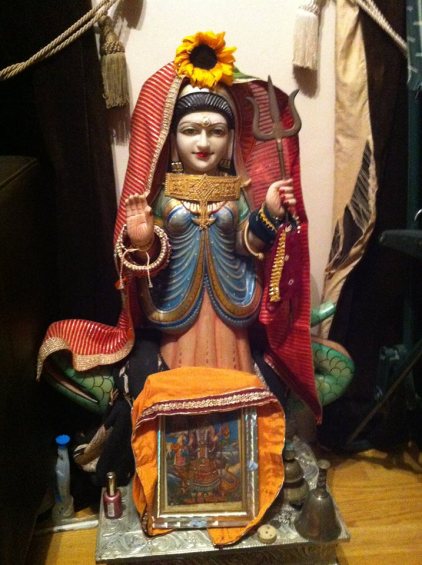
Sunflowers are significant in Hindu culture too. The symbol of the sunflower is known as the flower of the Sun (Suryar Mukki). The male Hindu Sun God (Surat dada) is worshiped through the sunflower and thus all the female Goddesses also love the sunflower. So in our Hindu culture if you are a devotee of a Hindu Goddess then it is custom to adorn their photo or statue with a sunflower…. it will please the Goddess very much and the male Sun God will provide equal blessings towards your home and family.

Goddess and sunflower
I have grown sunflowers in the past and they have given me so much joy. My family love sunflowers too. Especially my niece and nephew who have witnessed the tallest sunflowers grow in our garden this year. That is all thanks to The Big Sunflower Project.

The sunflowers have been a major blessing to me. Everything I could have wanted and much more. It’s also been quite spiritual for me too. The sunflowers have given me so much happiness especially at times when I’ve been down or at my lowest.

I have thoroughly enjoyed seeing the sunflower varieties bloom this year. The anticipation and excitement has given me so much happiness and sense of youth too. This year has been exceptional.

Thanks to the free seeds from The Big Sunflower Project I have been able to grow exotic and tall sunflowers this year. Two plant pots produced the tallest and highest yield of sunflowers. I am truly humbled and grateful to have been gifted the seeds. I’ll never forget how much happiness you have given me and my family in 2017. Thank you.

Donations to The Big Sunflower Project

This week, we have become aware that some people have been trying to donate to The Big Sunflower Project but these donations have been going instead to an organisation called 38 Degrees.

After an investigation, 38 Degrees traced one of the donor PayPal reference numbers to their Bee Seeds Campaign and specifically to the donation page for this campaign.

The donation has now been refunded and the donor has been notified by 38 Degrees that they now know this was not intended for them. It is hoped the other donations will be refunded shortly.

38 Degrees have also taken down their order page which was posted on the WOW Free Stuff website – this appears to be where confusion has arisen, as both the 38 Degrees campaign and The Big Sunflower Project were featured there at the same time.

If you think you have donated to The Big Sunflower Project but have not received your sunflower seeds, you may have been affected too and should check your PayPal receipt to see where your donation has gone.

If you find you have donated to 38 Degrees, you should contact them quoting The Big Sunflower Project in any correspondence. You will need to provide a screen shot showing your donation receipt and the reference number for your donation, in order to receive a refund.

Please note, if you are wanting to donate to The Big Sunflower Project, there are only two ways to do this, either:

The Big Sunflower Project will not receive donations that use any alternative donation facility, so donors will not receive sunflower seeds from The Big Sunflower Project. However, the project is happy to send seeds to anyone who donates in either of the ways detailed above.

Conrad and the sunflower

In 2013 an email arrived out of the blue, it told the touching tale of a child born with myotubular myopathy and a sunflower. Thank you Emma for taking the time to write, your kind words and for sharing lovely story with the world.

After trying for some time, last July, my husband and I found out I was pregnant. Earlier the same year my husband and I had some stumps ground out of our lawn leaving a few substantial piles of dirt in the yard. In one of the piles a sunflower grew – seeming to come from nowhere. We enjoyed the sunflower all summer and into the fall.

When our precious Conrad was born he was not breathing and was floppy. Long story short, after genetic testing we learned that Conrad had myotubular myopathy.

In my frantic search for information about Conrad’s condition, I came across the Information Point and read about the Sunflower Project. In that moment I knew that our mysterious sunflower was God’s way of telling us that He already knew what Conrad had and that he was preparing the way for Conrad’s life even while he was being knit together in my womb. Even when it seems that nothing is fair and the world does not make sense, God is in control and He has a plan for our darling little boy.

I am learning already that boys with MTM and the families who love them are very special people. Thank you so very much for all the work you have done to raise awareness about centronuclear and myotubular myopathy and for being here when I and my family needed you.

Sue (Bournemouth)

My name is Sue. Seven years ago my daughter gave birth to twins. They were delivered eight weeks early. A boy and a girl. Will and Isla. Isla weighed just over 3lb and Will weighed 2lb.

Isla was strong and healthy for such a small baby but Will had problems. He was floppy and his respiratory function was very weak. He was finally diagnosed with x-linked myotubular myopathy. This is a devastating disease carried by the females in the family but manifesting in the boys. We discovered that the range of the symptoms is huge and we were told that Will was 99% poorly. This diagnosis brought home to me the reason I had lost two boys but had successfully given birth to three beautiful girls. After investigations all three of my girls are carriers of the myotubular gene.

We rallied. We are a strong family. We watched Will struggle daily with the effects of this devastating condition. He was loved so much. He spent so much of his life in hospital fighting infections. We lost Will a month before his third birthday.

As a family we have always helped raise money to support The Myotubular Trust and continue to do so. The work these small charities do is huge and it is so important we get the word out about these dreadful conditions which are unknown by so very many, as the condition is not only rare but has a name which is so hard to remember. The work Toni is doing to bring recognition to these conditions is huge too. Continue to spread the word please, only then can research continue in the hope of eradicating centronuclear and x-linked myotubular myopathy.

I have a sunflower garden every year for Will and will support Toni in everything she does.

Thank you

sue3

sue2

Warden Abbey Vineyard

Warden Abbey Community Vineyard is situated between Old Warden and Cardington in Bedfordshire. Founded in 1136 the site was one of the earliest Cistercian settlements in England until the English Reformation led to its dissolution by Henry VIII in 1536. Vines were first planted at Warden Abbey Vineyard in medieval times by monks at the Cistercian Abbey of Warden and today the aim is for the vineyard to offer a unique community and educational resource, horticulture therapy, volunteering, and wildlife and heritage projects

Jane Markham, Vineyard/Project Manager says: Vines were first planted at Warden Abbey Vineyard in medieval times by monks at the Cistercian Abbey of Warden. The aim is for the vineyard to offer a unique community and educational resource, horticulture therapy, volunteering, and wildlife and heritage projects.

In 2013 one of our volunteers suggested we use an empty row in the vineyard to take part in The Big Sunflower Project. It was hard work digging over the row, but we looked forward to a stunning show of flowers later in the year.

We started our plants off in small pots which volunteers took home to look after, then planted them out at the end of May. The plants proved an instant hit with our local rabbits, who viewed the sunflowers as a fantastic new snack bar.

We thought we had protected the small plants by ringing them with cut off lemonade bottles but as soon as the shoots emerged above the top, the rabbits were getting them. So we planted up a second batch, and this time made small towers of our plastic bottles, and even used vineguards – tall tubes designed to rotect young vines.

Weeded and watered by our volunteers and visiting school children, there were times when they took up more attention than we should probably have spared, and there were times we doubted we would succeed in growing any at all. But in the end, it was so worth it. We finally got a good show of flowers and they looked fabulous. But more than that, our ‘sunshine’ row has been a great talking point for all our visitors who we’ve been able to tell about The Big Sunflower Project and hopefully help raise awareness of centronuclear and myotubular myopathy. The sunflowers have been a cheery presence in the vineyard over the summer and you can’t help smiling when you see them. I think the monks would have approved.

At the end of the year the vineyard saved the sunflower seeds for planting again in 2014.   Jane Markham says:

The saved seeds were planted in pots for us first by the grand-daughters of one of our vineyard volunteers. Then a number of volunteers took some of the pots home to look after them until they were ready to plant out in the vineyard. The first lot were planted for us by team members from OMRON Electronics who were on a community volunteering day in the vineyard.

The sunflowers were a great success as we learnt a lot of lessons from last year’s experience – especially about keeping slugs and rabbits at bay. During the summer of 2014 we started doing group tours of the vineyard and without fail each group has asked why we are growing sunflowers in a vineyard so it’s a great opportunity to raise awareness of The Big Sunflower Project and centronuclear and myotubular myopathy.  Also lots of questions about them at our Open Day where we had over 750 visitors.

Sunflower growers at Warden Abbey Vineyard in Bedfordshire

Rachel

In 2011 Rachel grew a variety of sunflower called Giant Russian which can grow anything from 6 – 15 feet tall. Rachel lives in Oswestry and two of her family are diagnosed with centronuclear myopathy. Rachel says:

When I heard about The Big Sunflower Project I wanted to get involved, as it’s a fun way to raise awareness of centronuclear and myotubular myopathy and sunflowers always put a smile my face.

I had recently cleared a big border of nasty weeds and needed something to fill the space quickly before the weeds showed me they were still boss. Behind the border was a high hedge, so the easy choice was the Giant Russian variety. I started my plants off on the kitchen windowsill and transferred them outside when they were a bit established, planting them one foot apart. They filled the space nicely and when they flowered, smiled over the top of the hedge at passers-by, meaning they could enjoy them too.

I had only ever grown sunflowers once before and they were the small ones which can be grown in pots with multiple flowers, so this was a first attempt at the big ones. They were a big success and the bees loved them.

I think the way for sunflower growers to out fox the slugs is to think big, even the hungriest of slugs will get full before making a big impact on Giant Russians. I didn’t feed my sunflowers, only gave them water – had I fed them too, I fear they may have turned into Triffids’.

Sunflowers grown by Rachel in Oswestry

Pernille

Pernille Rahr Maansen lives in the countryside of Northern Jutland – part of Denmark. Pernille has taken part in the project several times, harvesting seeds from the first year, to plant again the next year. Pernille says:

My husbands younger brother and his wife, have had two boys who died because of myotubular myopathy, one right after birth and one lived to be 1 1/2 years old. I learned about the project from my sister in law who had some extra seeds and asked me, in the spring, to grow them and share the pictures. I had both yellow and beautiful red ones. They didn’t grow to be very high, I think the highest was 1.40 metres and the flower not as big as I’ve seen them but they have had several flower heads on each and my yellow flowers flowered into November.

I hadn’t grown sunflowers before and had no clue how to do it best, to get most flowers to grow. So I took the seeds and planted them in pots and put them on my terrace, because it is nice and sunny there in springtime. I think I planted them in late April and then I waited to see the results. I think that 3/4 of the seeds were successful – as they grew bigger I planted them in bigger pots and when they were about 0.5 – 0.8 metres.

Pernilla

Pernilla lives in Sweden and in 2013 grew a sunflower in memory of her son Ragnar. Pernilla says:

In early January 2010 our second child Ragnar was born. He was diagnosed with MTM1-x. A year or so after he left us I got in contact with the Information Point as I saw that the Big Sunflower Project was celebrating its third year the same as our Ragnar would have been. What a wonderful thing to do for him and all other kids like him.

I grow some sunflowers last year by myself but they didn’t get to flower. This year I put in a bit more love and attention. And I got four big plants. My daughter helped me and they are really beautiful. I also enjoyed seeing all the other flowers that people grew.

Moorsholm in Bloom

Moorsholm in Bloom participated in The Big Sunflower Project for the first time in 2014. Below they write about taking part.

Moorsholm is a village on the edge of the North York Moors. Its name is of Viking origin and means a Moor.  RHS Britain in Bloom began in 1964 and today is one of Europe’s largest horticultural campaigns with more than 1,600 cities, towns, villages and urban communities participating each year to show off their achievements in  environmental responsibility, community participation and horticultural achievement. Barbra from the groups says:

Moorsholm in Bloom was formed in 2009 as a volunteer group mainly working in the grounds of St Mary’s Church. We found out about the work of The Information Point quite by chance but were really keen to show our support. Coincidentally the RHS were also using sunflowers in their campaigns to celebrate their 50th anniversary and we had to grow a really large batch of them, so we organised a seed sowing morning with the children in our Little Planters group as we had decided to use the seeds given to us by the Information Point in our community garden. The sunflowers were sown into fibre pots which can be planted straight into the ground without any disturbance but disaster struck just as our little seedlings were growing well. They were just such a tasty snack for the armies of slugs which have been around this year.

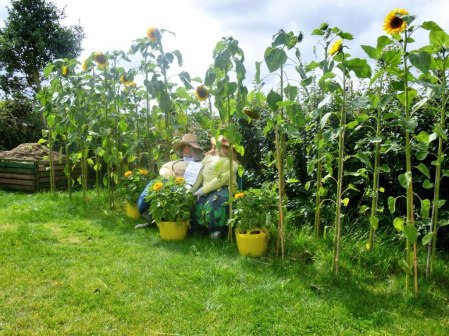
A second batch was quickly sown and the pots set on sharp grit which did the trick. Lovely healthy plants went into the ground in early June and they grew happily over the next few weeks. We grew Russian Giants together with a smaller variety called Teddybear. They have been fabulous growing to about ten feet high and admired by villagers, visitors and the National RHS judges who had their photos taken with them. We gave them a bit of company in the form of our anniversary scarecrows Roy and Al who loved sitting amongst the flowers.

The Information point is doing a great job in highlighting their work and we are proud to support them.

Moorsholm-scarecrows