Mike

Mike has taken part in The Big Sunflower Project since 2016 and has supported the project on his blog Flighty’s Plot since then.

In 2017 Mike wrote:

I don’t have a garden just a half-plot allotment, which is only a few minutes walk away from home, where I grow soft fruit, vegetables and lots of flowers including sunflowers.

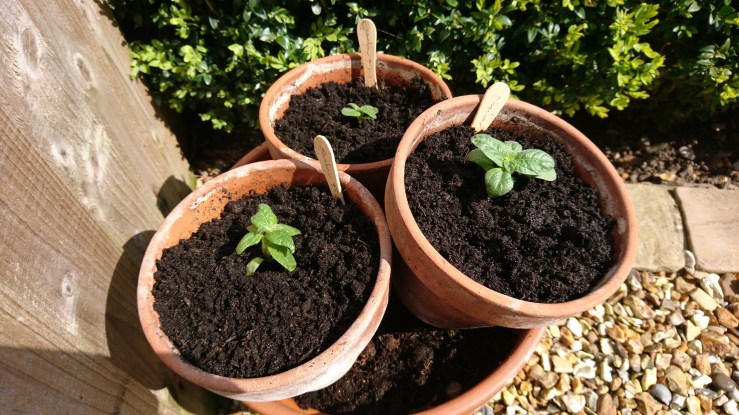
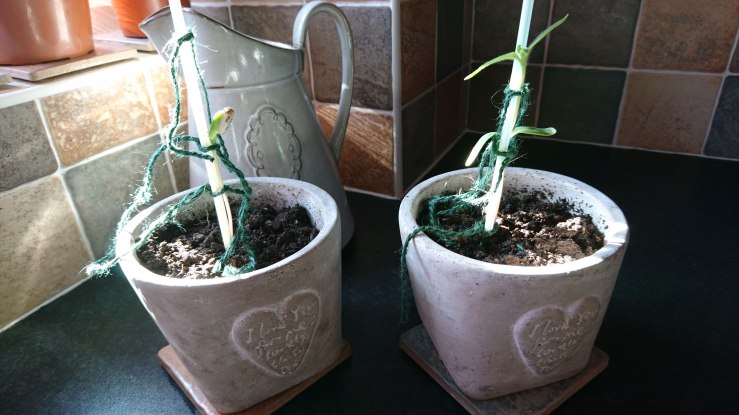
One of the varieties I have grown was the knee-high Music Box which did really well so I’ll be growing it again. As I don’t have a greenhouse I sowed the seeds in small pots on the windowsill at home. When I planted them out on the plot I sprinkled some organic slug pellets around them. The plants produced numerous colourful flowers over a long period and didn’t need staking.

mike

It’s said that sunflowers bring out the happy child in everyone. They certainly do with me, which is why I grow them as one of my favourite flowers and I’m happy to support this good cause, which includes linking to this website on my blog.

In 2018 Mike wrote:

As much as I would like to grow impressively tall sunflowers my allotment is in the middle of a rather exposed site where wind damage to taller plants can occur, even when they’re staked and tied.

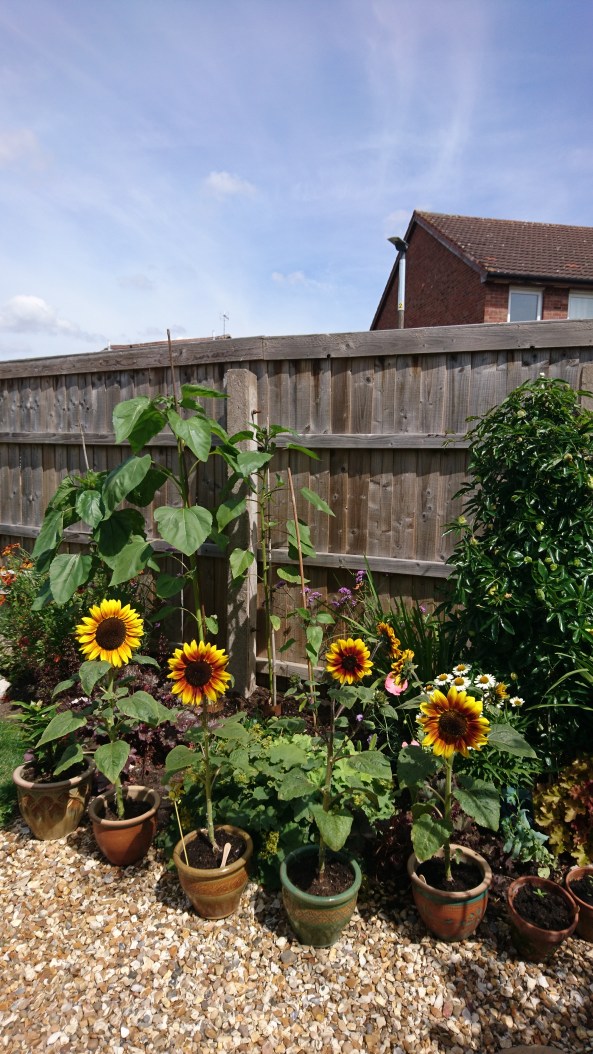
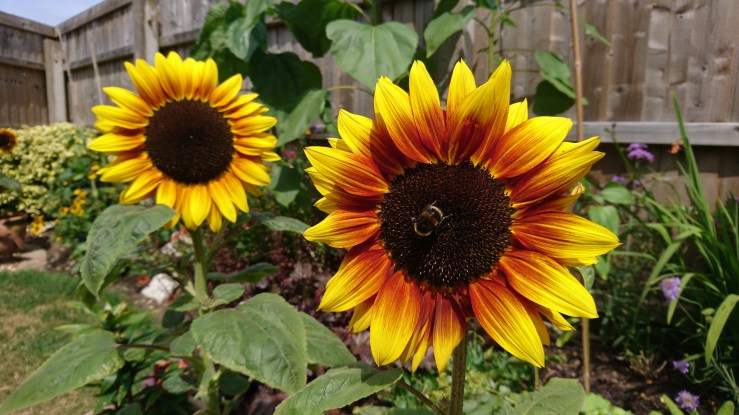
The past couple of years I’ve grown the knee-high sunflowers Music Box, which only grow to around 30″/75 cm and generally do well.  If you’re hoping to take part and only grow in containers then these are an ideal variety. They have numerous flowers in various colours – usually yellow, some bi-coloured red/yellow and occasionally lemon – all with dark centres.
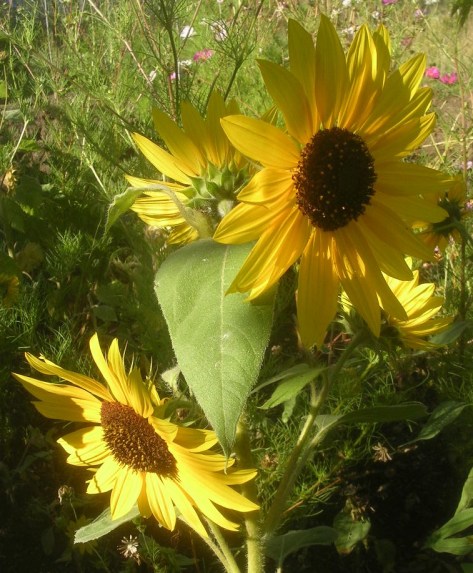
Musicbox sunflowers

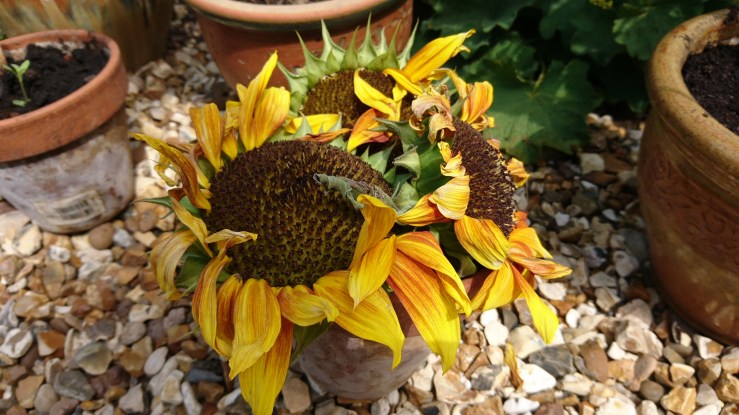
I grow them in an area I call sunflower corner where they flower from early July well into autumn. As with all the flowers that I grow they are attractive to bees and butterflies. I save some seed heads and leave others for the birds or to self-seed. This year I’ve saved a lot of these seeds to donate to Toni to send to participants in The Big Sunflower Project 2019.

In 2019 Mike wrote

I had a good year on my allotment with one of the highlights being the sunflowers which did really well.  As usual I grew the knee-high variety Music Box which got rather overshadowed by taller ones so I’ll be growing them in a separate area next year.   The taller Ring of Fire not only did well but four blooms that I picked and entered in one of the floral classes at my horticultural society’s annual show in early September won a first prize, much to my surprise and delight.

I collected and sorted lots of seeds from both of these varieties which I’ve sent to Toni for use in next years project.  I’ll be growing them again along with the new to me variety Sonja which grows to around three to four feet with plenty of four inch dark-centred blooms which are golden-orange.

It never ceases to amaze me how sunflower seeds planted in the spring germinate and grow in just a few months, with the wonderful flowers not only making us smile but also providing food for bees, birds and butterflies.
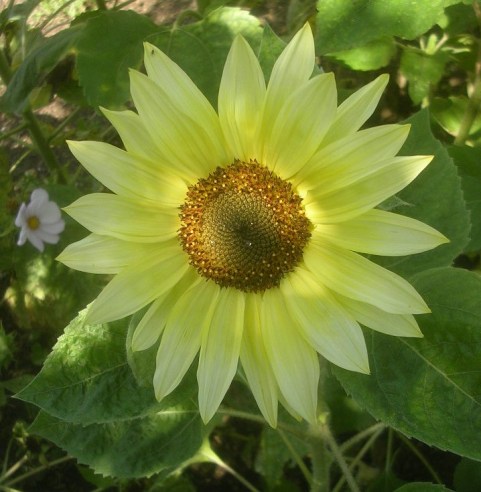
Sunflower

Richard Lee Primary School

2018 was our first year being involved in The Big Sunflower Project. We wrote and asked if we could be a part of the project and one afternoon, we received some Russian Giant sunflower seeds in the post. The children (aged 3/4 years old) were so excited.

We talked about how some children are born poorly and by growing sunflowers, we can think about those children as the sunflowers grow taller and stronger. The children learnt we had to care for the seeds as they grew into seedlings, needing soil, water and sunshine.

We enjoyed regularly measuring them. When our tallest grew to over 9ft tall, a photo even made it into the local newspaper.

In the summer, we had a beekeeper visit us. He told us bees are important in our garden, and their favourite coloured flowers are yellow, blue and white. Lots of bees have visited our sunflowers this year.

When the tallest stem broke in strong winds, learning still went on. We learnt that the stem measured 20 rubber bricks long. Then we used tweezers to harvest the seeds for next year. We also put some seeds in a hollowed out pumpkin to feed the birds.

Sunflower

A year in the life: 20 October 2018

It’s late October and today, for possibly the last time this year, I am writing this sat in the garden (albeit bundled up in a big cardigan). It’s Saturday, the sun is shining and the sky is blue, so I’m pretending like it’s summer.

Sunflowers

This year many of the seeds I planted germinated. I planted my sunflowers out anywhere around the garden where I found a space and from early August was rewarded with huge yellow, red and orange flowers all over the place. The sunflowers here this year were nothing short of magnificent. Some of them I thought would never flower – like a well known beanstalk, they just grew and grew and grew.

Sunflowers

And although not quite the sight they were, there are still sunflowers in bloom today and a couple of sunflowers still to flower – whether these can survive the night time frosts which are surely on the way remains to be seen but right now they are giving it a good go.

Red sunflower

With it being such a lovely day today, I have sunflower heads full of seeds drying out in the sun. My growing success this year means I should have a fair few seeds for growing next year. However, earlier this year I also applied to the Skipton Building Society Grassroots Giving scheme, for a £500 donation, with the aim of securing the future of the project for a further year.

Orange sunflower

The project was successful in being shortlisted for the third time and it is lovely simply for the project to be recognised, however, winning a donation would be a huge help in funding the increasing cost of seeds and postage.

Winners of the donation are decided by public vote, so support from project sunflower growers and those affected by centronuclear and myotubular myopathy is vital. If you voted, thank you so very much. Winners will be announced on 5 November.

Sunflower heads

2018 was the eighth year of the project. This year more than 850 sunflower photos were received and sunflowers were grown in the UK, Europe and the USA. Sunflower growing season in this part of the world is now almost over,  so all that remains is to say a huge thank you to everyone who helped raise awareness of centronuclear and myotubular myopathy by taking part in project again this year and sharing their beautiful photos.

And if you are in a part of the world which is just about to get its summer, please consider picking up the baton and taking part. I can think of nothing better than receiving sunflower photos from foreign climes during the cold dark days which are to come.

Grassroots Giving 2018

The Big Sunflower Project has been shortlisted for Grassroots Giving 2018 to receive a donation of £500. Over 740 applications were received and 377 groups have now been shortlisted.

Funding such as this is crucial to The Big Sunflower Project continuing and the winners will be decided by public vote, so if you like what we do please vote below for us to win.

Voting closes on 12 October 2018.


Grassroots Giving logo

A year in the life: 25 August 2018

The first of my giant sunflowers started to bloom in early August and the second the day after. I would have had a sunflower earlier but windy weather at the end of July saw the first one off just as the flower began to open.

Giant sunflower.

After months of nurturing they both flowered in a direction where I could not see them easily, choosing to look out over the street, instead of the garden but both plants had many flower buds and the later flowers are being more obliging.

Giant sunflower.

This year my success rate has been high. I had some seeds that didn’t germinate and a few plants have been lost to the weather but dotted around the garden today I have around 15 large variety sunflowers, some growing to dizzying heights and my dwarf sunflowers are still flowering too.

Giant sunflowers.

The last few weeks have seen sunflower photos arriving almost every day from across the UK but also from Europe and the USA. This time of year is almost like a second Christmas or birthday, each sunflower a gift which is then shared on the project social media pages, so helping raise awareness of centronuclear and myotubular myopathy with its beauty. Currently, the project has received over 600 photos from 97 participants.

Sunflower heads.

Now in late August, there is a chill in the air in the mornings but this afternoon has been warm and sunny and I chopped down the first of the giant sunflower heads that had started to go over. Strangely, it didn’t feel bad doing this, the flowers were as big as my hand (the leaves even bigger) and are bursting full of seeds – once the seeds have dried out, it will be possible to plant them next year. Dead heading should encourage the other buds into bloom too. Also I still have many sunflowers to flower and the ones that are in bloom already, have today looked amazing sunning themselves against the back drop of a very blue sky, so I am looking forward to September in the garden.

Dark red sunflower.

A year in the life: 25 July 2018

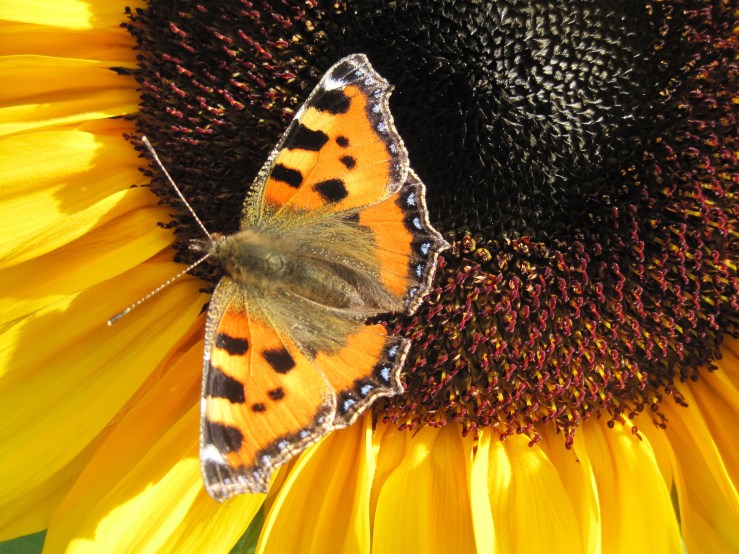
It’s getting towards the end of July and all but one of my dwarf sunflowers, which was planted later than the others, are now in bloom. They are around two foot high with many flowers and are loving the proper summer we are having this year. The bees and butterflies think they are in sunflower heaven and it is really quite joyous to watch them going about their business each day.

Dwarf sunflower.

I am loving the weather too but I am spending a lot of time watering. The neighbours I am sure, think the crazy watering woman is at it again, every time they see me with my watering can but when plants are in pots or under the roof line, the rain does not get to them like they need and even a heavy rain shower for an hour doesn’t do much for those planted in the borders after weeks of intense sun.

The larger varieties are coming on nicely too. Some of them are making a bid to expand their horizons and will soon be peering over the garden fence at passersby. Many of them now have flower buds but no actual flowers yet, so I am giving them tomato feed for encouragement.

Sunflowers

As usual when I planted my sunflowers, I tagged them so I knew what they were but despite my best intentions the names have mostly washed away, so in a lot of cases, it is going to be sunflower surprise again.

Mercifully the slugs and snails have kept their distance this year, although I did find the biggest slug wedged between a flower bud and a cane after some rain recently. Sadly it wasn’t willing to listen to reason. We had a disagreement as I proceeded to try and evict it. I won but … ugh. However, said sunflower seems to be doing okay, despite the best efforts of the slug to eat it.

Dwarf sunflowers.

I am hoping to have another go at harvesting seeds this year. Last year, although the project did receive some seed donations, I had to purchase sunflower seeds for the first time since the project began, which meant less money was available for the admin costs of the project. So as flowers fade, it’s off with their heads, in the hope that the seeds will dry out and can be used next year. You can read about how to harvest seeds on this website.

If you decide to have a go too  and would like to share some of your bounty with The Big Sunflower Project 2019, please get in touch.

Sunflower heads drying out in the sun.

A year in the life: 6 May 2018

It is now almost two months since I planted my dwarf sunflower seeds. Being a dwarf variety the plants have been growing happily on the kitchen windowsill for most of this time with the occasional visit outside, to prepare them for being permanently out in the  big wide world. Six of the eight seeds I planted grew fine and I planted a couple more a few weeks after the initial planting to make up for the two that didn’t grow.

Each year it never ceases to amaze me how I can plant my seeds on the same day at the same time but how they grow at different rates. There are always the high achievers racing ahead, while others, take their time, wondering what all the fuss is about. However, overall what I have learned during the time I have been growing sunflowers, is that they flower in their own sweet time. In my case last year, this was November and while I have had sunflowers bloom during the winter months before, they have usually been second flowerings, so I am hoping for a better showing this year.

Dwarf sunflowers

Over the last few days, after a very long winter, it seems like everything in the garden is coming back to life and I can almost see things growing before my eyes, so today I transferred my dwarf sunflowers outside. Now even the biggest plants look tiny in their new  homes but the weather is set to be hot and sunny for a few days and I wanted to make the most of it. Hopefully I am giving them a good start.

Presently sat in an area of the garden which gets full sun all day, none of the plants appear to be sulking about being re-housed but later I will be putting copper rings around them to keep the slugs and snails at bay and will move them into the shed overnight.

In previous years I have found using the cut off bottoms of plastic milk bottles to be quite effective at protecting my sunflowers but last year they were not enough to protect my plants from a mass invasion of slugs and snails that arrived in the garden during a wet spell, so I invested in copper rings and will be using these from the start this year.

Dwarf sunflowers

Since planting my dwarf sunflowers I have also planted some giant sunflower seeds and these are also growing fine indoors but I am going to let them get a bit bigger before I pot them out, as currently they look as if they would make a good meal for a hungry slugs and snails.

And now the dwarf sunflowers have moved out of the house, I have been able to sow a few more large varieties indoors – Sunburst Mixed and Autumn Time, neither of which I have grown before and Copper Queen which I have. Watered and sat behind a hot window, hopefully it won’t be too long  before I have some more sunflowers growing.

Giant sunflowers

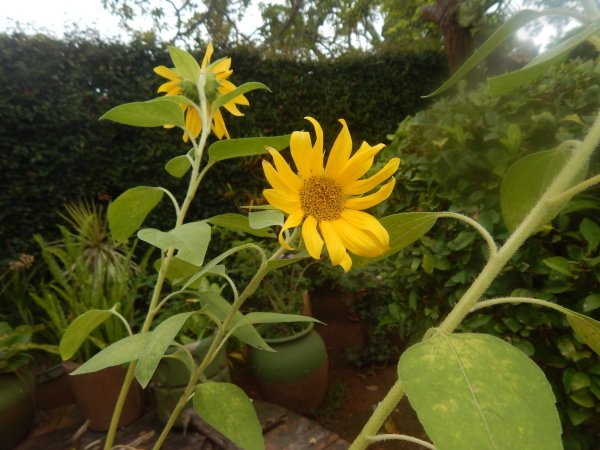
Frank: South Africa

The Big Sunflower Project welcomes participation from around the world. Sadly, due to import and export rules, we are unable to send seeds outside of Europe but that doesn’t stop people joining in, with sunflowers having been grown in many places across USA, Ecuador and Dubai.

Sunflowers

In early 2018, the project received a lovely email and photos from Frank in South Africa – Frank is diagnosed with the dominant form of centronuclear myopathy which made the email all the more special.

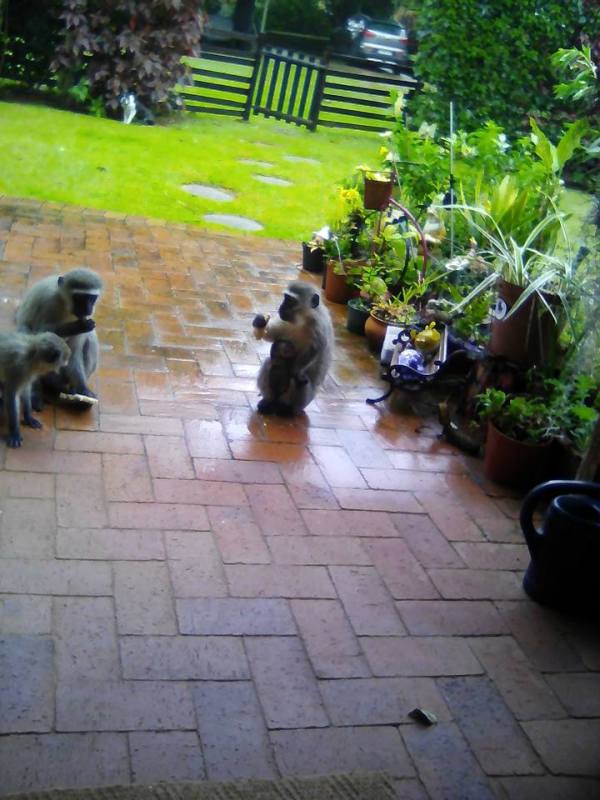
Frank grew the sunflowers in his lovely garden in Durban and they were subsequently eaten by the local troop of Vervet moneys, making their daily trek across the yard.

Vervet monkeyVervet monkeysVervet monkeys

A year in the life: 10 March 2018

2018 marks the eighth year I have been growing sunflowers and this year I thought I would try and record my sunflower growing.

Seed distribution for The Big Sunflower Project 2018 began in January and there are now 252 places plotted on the project map, with seeds having been posted to destinations in the UK and Europe, to people affected by centronuclear and myotubular myopathy, charities, community groups, good causes and more.

There isn’t much in the way of planting going on yet – today is Saturday 10 March and this time last week the UK had ground to a halt because of heavy snow and freezing weather conditions. Winter 2017/2018 has been the coldest winter we have had in the UK for a number of years and there has been ice and snow on an off since before Christmas.

I tried planting some seeds in my shed getting on for a month ago now but there’s nothing doing. To be honest, I wouldn’t want to grow either given the weather we have had but it got me out the house for a short time, on a more mild day.

Solar Flash dwarf sunflower

However, today I have started in earnest and planted eight dwarf sunflower seeds. They are a variety call Solar Flash (see photo above of one I grew earlier) which I have planted for a number of years and they will grow to around two or three foot.

The good thing about these is that they will grow happily in the house for quite some time and because they are a dwarf variety, they don’t get leggy like the larger types. If I was to start those now, they would be ready to plant outside in a couple of weeks and as I don’t have a greenhouse, this will be much too early, so I will plant those at a later date.

Preparing to plant sunflowers.

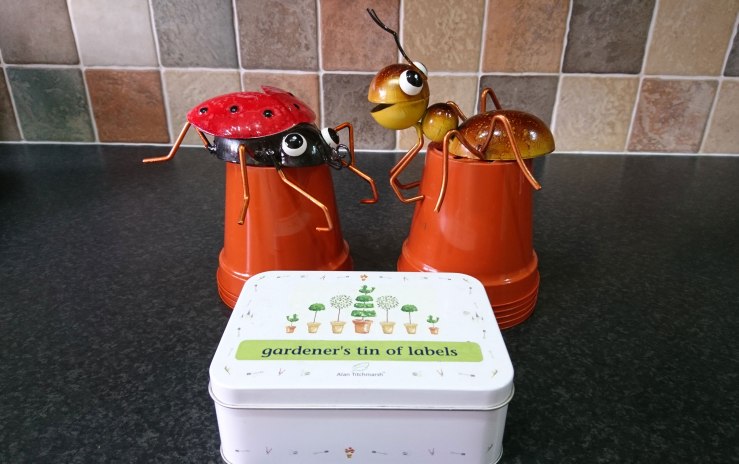
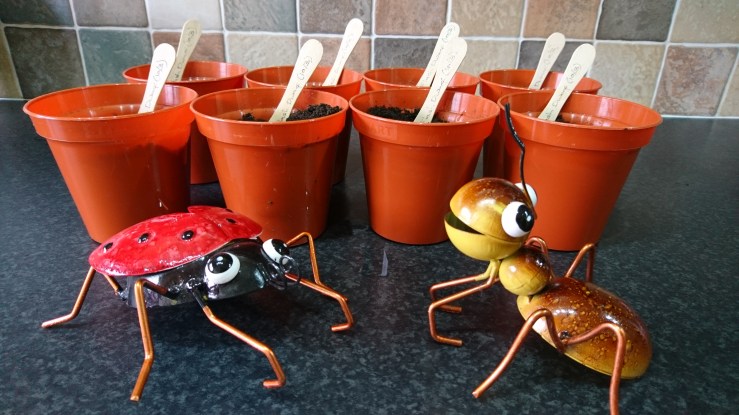
So today pots have been retrieved from under the kitchen sink and filled with compost. I had a bit of help from some new friends found in a garden centre yesterday. To be honest though they weren’t much help but made for pretty photos.

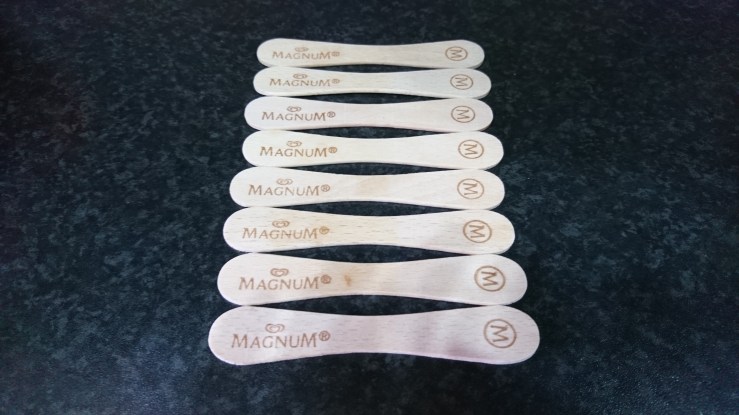
A single seed was planted in each pot and watered. This year I am using ice cream sticks to label my plants with the name of the sunflower and the date it was planted rather than buying something expensive that does the same thing.

I label my plants every year as I grow different varieties but if all my plants retain the correct label or any label at all later in the year, it will be a miracle. I am using sticks from Magnum ice creams (I highly recommend the double raspberry and honeycomb ice creams) but other brands of ice cream are available.

Ice cream sticks for labeling sunflowers.Sunflower seeds planted and labelled.Sunflower seeds planted and labelled.

Now it is a waiting game … over the next couple of weeks I will give the seeds warmth, light, water and words of encouragement and hopefully, towards the end of March will be rewarded with some sunflower seedlings.

More photos

Suspension of seed distribution

This week The Big Sunflower Project has been promoted on the Gratisfaction, Wow Free Stuff, Latest Deals, Offer Oasis and Free Stuff Search websites and their social media pages. The project has also been included in e-newsletters that these organisations have sent to their subscribers.

None of these organisations asked before doing this, resulting in an overwhelming number of seeds requests being received and we have been forced to suspend seed distribution for the time being. This is the second year that Gratisfaction and Wow Free Stuff have promoted the project without asking and caused seed distribution to stop.

All the organisations have been contacted and asked to remove the information from their websites and social media. Gratisfaction have removed the information from their website but are marking requests on their Facebook page as spam. Wow Free Stuff, Free Stuff Search, Latest Deals and Offer Oasis have not responded. And e-newsletters, once sent, can not be recalled. Sadly as a result of these promotions, it will be impossible to send seeds to everyone who has applied.

The Big Sunflower Project is an independent non profit organisation which relies on funding and donations to keep going – the project is not associated with any freebie websites and project seeds are not freebies or free samples as has been promoted.

The aim of The Big Sunflower Project is to raise awareness of rare neuromuscular conditions known as centronuclear and myotubular myopathy.  The project raises awareness by sending seeds to people who have never heard of the conditions and requesting photos in return. The photos are posted online which again raises awareness of the conditions.

There is no charge for seeds or for the cost of postage but  donations are welcomed – these secure the project for  future years and enable seeds to be sent to as many people as possible each year.

Seed distribution will re-commence but at present it is not possible to say when this will be, as it is going to take some considerable time to read through the many emails that have been received.

When distribution begins again, priority will continue to be given to those affected by centronuclear and myotubular myopathy, community groups, good causes and educational establishments and it will be announced on the Facebook project page and The Information Point Twitter page.

Thank you so much everyone for your interest in The Big Sunflower Project. Anyone not chosen to receive sunflower seeds, is still welcome to take part in the project. Please advise if you taking part so you can be included on the project map.